Capable, Not Careless
How the way you carry yourself can quietly change the odds — and why being your family’s protector is something you should take seriously, without ego and without apology.
The Selection Process
Every day across Europe and beyond, we hear of violence, robberies, assaults, opportunistic crime. Most people process these stories and move on. But if you’ve spent as much time on nightclub doors as I have in a previous life, or if you’ve simply paid close enough attention to the world around you, you start to understand something the headlines rarely say.
Most predatory crime isn’t random. It’s a selection process.
People who intend to do harm tend to choose carefully. They look for those who appear distracted, hesitant, unaware. The person who looks like they won’t give chase. Who won’t resist. Who won’t cause problems. They are, in a very real sense, looking for the path of least resistance, and they are often remarkably good at finding it.
In one of the most revealing interviews ever conducted with a convicted child predator, one of the most prolific in US history, investigators asked what most influenced his target selection. His answer wasn’t about the child. It was about the father. Did he look like a threat?
That’s a disturbing thing to sit with. But it’s also one of the most instructive things I’ve encountered on this subject, because it makes clear that capability, or even just the credible appearance of it, matters in a very practical way. Not as armour. Not as aggression. As a quiet signal: not this one.
The Spain Photograph
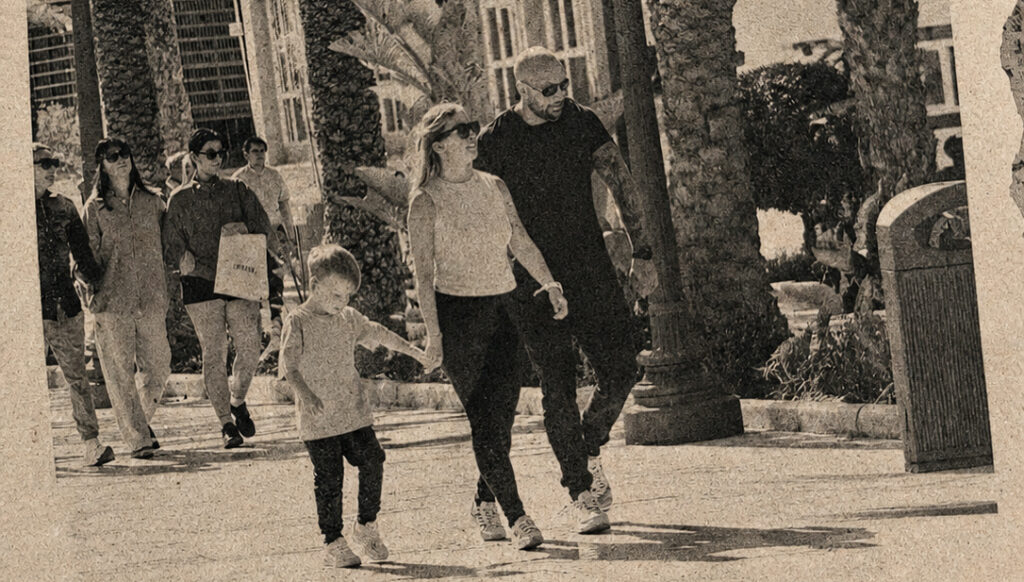
A few months ago I was walking through Spain with my wife. One of those tourist traps where someone takes your photo, prints it onto something made to look like an old newspaper front page, and hands it to you expecting money. We played along, posted the picture, and a few people in the comments said I looked more like my wife’s bodyguard than her husband.
I took that as a compliment. Because isn’t that exactly the point?
All black. Sunglasses. Athletic build. Moving with purpose. Whatever the combination, something about how I was presenting myself that day read as capable, as someone who would give chase, who would not be a clean getaway. In a street full of tourists, most of them heads down and distracted, the chances are that anyone looking to cause trouble would have scanned past us and found an easier option.
I’m not claiming to be some ex-SAS operator. I’m not saying I’m untouchable. What I am saying is that nine people out of ten, sizing up a crowd, would have quietly moved on. And in a world where the tenth person is the worst-case scenario, shifting the odds that far already matters.
Shouldn’t that be the standard we hold ourselves to, especially as husbands and fathers? Not invincibility. Not aggression. Just the quiet, genuine capability to make the people around us safer, and to make those who might wish them harm think twice before trying.
What Eight Years on the Doors Taught Me
I worked the doors from eighteen to twenty-six. In that time I was exposed to more confrontation than most people encounter in a lifetime. It wasn’t something I went looking for, it was simply the job, and it educated me in ways nothing else has since.
The longer I did it, the more I found myself tuning into environments in a way I hadn’t expected. You start reading people the way you’d read weather, looking for what’s coming before it arrives. It’s not a skill you decide to develop. It develops because it has to.
Body language is the loudest thing in any room. The way someone moves as they walk in, the set of their jaw, whether their eyes are scanning or fixed on something specific, how they’re carrying their hands, will often tell you their intention long before anything happens. You learn to read it without thinking. And once you can read it, you can rarely unsee it.
In a confrontation, certain things become instinct. Don’t let people break your personal space, not because of pride, but because space is time. The closer someone is, the less time you have to respond to whatever they do next. If someone starts closing that distance in a tense exchange and there’s no good reason for it, that matters. You can and should manage it calmly, a step back, a steady hand gesture, but you don’t ignore it.
Watch for the shoulder turn. When someone turns their body away mid-confrontation, it’s rarely because they’re backing down. Turning the torso makes them a smaller target and loads their dominant side. It happens half-consciously, which is exactly why it’s such a reliable signal. I once spotted it developing on the door before the lad had fully committed to it, a short, sharp leg kick to the ankle stopped the whole thing dead. From the floor, his entire demeanour changed in seconds. No escalation, no drama. The moment was read early enough that the response could be minimal. That’s the ideal, not the fight, but the avoidance of one through timing and awareness.
And always, always, watch the hands. The mouth does the talking but the hands tell you what’s actually coming.
I worked alongside a Polish guy named Marius for a while. Champion fighter. Built like the side of a bus. One night, a young lad, drunk, stupid, performing for his mates, walked up and spat in his face.
I couldn’t believe what I was watching. And then I couldn’t believe what Marius did: he wiped his face slowly and just stood there. Calm. Still. Said nothing.
Afterwards I asked him how he hadn’t flattened the guy. He looked at me and said, in his broken English: “Why I hit him? He’s no danger.”
That’s stayed with me ever since. That is what genuine capability looks like. Not anger. Not performance. Not ego. Nothing to prove, nothing to show. Just a man completely confident in what he was. Had that guy pushed things further, I have no doubt he would have regretted it very quickly. But Marius didn’t need the world to know that. He already knew it himself.
Read the Room
We live in an age of deliberate distraction. Headphones in, phone out, head down. For most of daily life that’s fine. But it comes at a cost most people don’t notice until they’re already in a situation they weren’t ready for.
Awareness is the foundation everything else is built on. You can carry yourself with all the quiet confidence in the world, but if you’re clearly somewhere else mentally, oblivious to what’s happening around you, opportunists will notice. The phone in your hand with your attention buried in a screen is not just a target. It’s a signal that you’re not present. And people who prey on others read that signal fluently.
The flip side is equally true: the moment someone with bad intentions clocks that you’ve already clocked them, that you’ve noticed, that you’re tracking what they’re doing, most of the time they’ll move on. They want ease. They want surprise. Take those away and you’ve already changed the equation without doing or saying a single thing.
The moment you step into a closed environment, a bus, a train, a lift, your awareness should quietly shift up a gear. Not anxiety. Not suspicion of everyone around you. Just a quick, calm inventory. Where are the exits? Who’s behind you? Is anyone paying a different kind of attention to the surroundings than the situation calls for? These questions take seconds. Most people never ask them at all.
If you’re with your family, the responsibility sharpens. You are not just looking out for yourself. The people with you are, in that moment, trusting you to be present, even if they don’t know that’s what they’re doing.
Stay present. Phone away when you’re moving through public space. Headphones out when the environment changes or feels different. Look up. Look around. Know what’s behind you. It sounds simple because it is, and most people aren’t doing it.
In a tense exchange, don’t allow your personal space to be broken without responding to it, calmly, without drama. A step back, a steady hand. And always try to talk your way out first. But there is a point where someone has stopped listening, where the words have become noise and a decision has already been made. Recognising that moment, and not waiting past it, is a skill. One that only comes from paying attention.
The Balance
There’s a version of this idea that goes wrong, the person who reads something like this and decides they’re now untouchable. That’s not what this is about, and if that’s the takeaway, it’s the wrong one.
Bad things happen to capable, switched-on, prepared people. The world is not predictable and no amount of awareness or physical capability guarantees anything. What we’re talking about is odds. Probability. The difference between being an obvious target and being a far less attractive one. It’s not a forcefield. It’s a filter.
There’s a subtler point here too. The person who tends to attract the most trouble is rarely the quietest one in the room. It’s the brash one, the loud, ego-driven presence whose bravado outpaces their ability. That kind of performance is a magnet for exactly the wrong kind of attention. It signals insecurity, and insecurity invites testing.
Quiet capability is the opposite. It doesn’t need an audience. It doesn’t need to announce itself. Sun Tzu wrote about the power of making enough noise to win before a battle starts, but the deepest version of that idea is the man who doesn’t need to make any noise at all, because what he is speaks clearly enough on its own.
That’s what Marius understood standing there wiping his face. That’s what comes through in a photograph of a man walking through a Spanish street with his wife. And that’s what anyone, with the right habits and the right mindset, can and should be working toward in my opinion, based upon my life experiences, not perfection, not invincibility, but the kind of grounded, capable presence that makes most trouble quietly look the other way.
None of this is encouragement to seek confrontation, to take unnecessary risks, or to stand your ground against someone armed. If someone wants your phone or your wallet, give it to them. What this is about is everything that happens before it gets to that point, and the significant influence you have over whether you ever get there at all.