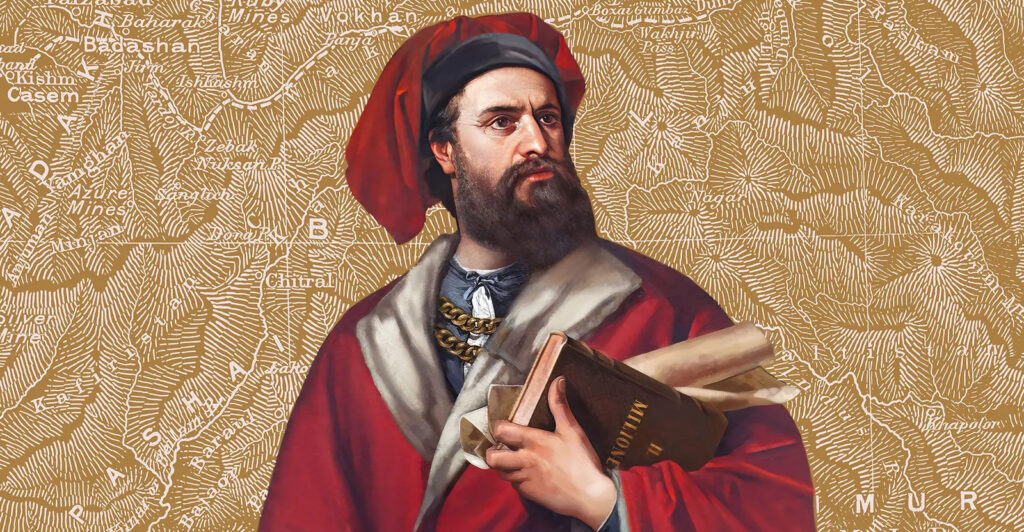
What Marco Polo Knew 800 Years Ago That Most People Still Haven’t Figured Out
Last week I took my wife to Venice to celebrate our 12th wedding anniversary. The moment you land, you’re already being introduced to Marco Polo, the airport carries his name. We got onto a gondola on the first day and the gondolier, unprompted, pointed out a building along the canal. “That’s where Marco Polo was born,” he said. “It’s an opera house now.”
I’ve heard the name throughout my life. But if I’m being honest, that was about the limit of my knowledge. That evening, whilst my wife was getting ready, I started reading. I knew he was a merchant who had travelled, but I didn’t realise just how much of a thought leader he was, or how far ahead of his time. So much so that 800 years later, his observations aren’t just relevant, they’re lessons most people are still missing.
This one doesn’t have much relation to fitness. But it has everything to do with living a capable and fulfilled life.
Over the last three years I’ve travelled over 165,000 miles, 6.5 times around the world. China, Europe, the US, Canada, iv been on a mission to see as much of the world as I can. And sitting in Venice reading about a man who did the same thing in the 1200s, on foot and horseback, I realised without ever planning it, so much of what Marco Polo observed still holds true today. I’d been living his lessons without knowing it.
Here’s what he figured out 800 years ago that most people still haven’t.
The world is far bigger, richer, and more connected than you think
Marco Polo’s book, The Travels of Marco Polo, was essentially a medieval travel diary. He described the Mongol Empire, the wealth of China, the trade routes of Asia. When he came back to Venice and started talking, most people didn’t believe him. Paper money? Cities with populations that dwarfed anything in Europe? Coal used as fuel? It sounded like fantasy.
The big takeaway from his entire journey, if you strip everything else away, was this: the world is far bigger, richer, and more interconnected than most people realise.
That was true in 1300. It’s still true today.
Most people operate inside a very small world. Same town, same routine, same conversations, same assumptions about how things work. I’ve seen it every time I travel for work. People who’ve never left their region will tell you with confidence how business works, how people think, what’s possible. And then you land in Shenzhen or Shanghai and watch a manufacturing operation that would make most Western businesses look like they’re moving in slow motion, and you realise the map most people are working from is badly out of date.
Get out of your bubble. Regularly. Your assumptions about what’s possible are almost certainly smaller than reality.
Opportunity is everywhere — if you know what you’re looking for
Marco Polo was a merchant first. His observations weren’t just curious, they were sharp. He paid close attention to silk production, spice trade, salt monopolies, shipping routes, taxation. Much of his book reads less like a travel diary and more like a businessman’s guide to the opportunities available across Asia.
He walked into every new environment asking: what’s here, how does it work, and what can I learn from it?
I think about this every time I travel for work. The China trip a few weeks ago, 1,800 manufacturers under one roof. Most people would find that overwhelming. I found it one of the most valuable weeks of the year. You just have to show up with the right lens. Not “this is strange” or “this isn’t how we do it at home” but “what’s here that I haven’t seen before?”
Curiosity is a competitive advantage. Most people stopped being genuinely curious a long time ago.
Adaptability isn’t optional — it’s the whole game
Polo left Venice at 17. He didn’t return until he was 41. In between, he learned Mongolian, navigated the court of Kublai Khan, ate what was in front of him, and adapted to cultures so different from his own that most Europeans couldn’t even imagine they existed.
He didn’t wait for the conditions to be right. He adapted to the conditions as he found them.
I think about this when people tell me they couldn’t train on a work trip, or they couldn’t eat well because they were travelling, or they couldn’t focus because they were out of their routine. The ability to perform regardless of the environment is one of the most underrated capabilities a person can have. Not just in fitness, in everything.
Polo had no guidebook. No safety net. No way to know what came next. He just kept moving and kept adapting. That’s the whole skill.
What you observe matters as much as what you do
One of the things that strikes you when you read about Polo’s journey is how much he paid attention. He wasn’t just moving through places, he was watching, recording, thinking. The postal system of the Mongol Empire. The road networks. The military structure. He saw things that Europeans had no framework to understand, and he wrote them down anyway.
Most people move through life without really observing it. And here’s the irony, we think we are. We’re recording everything. Every meal, every view, every moment handed straight to a phone screen and posted before we’ve even processed what we were looking at.
But there’s a difference between recording and observing. Research actually backs this up, people who photograph experiences rather than live them tend to remember less and enjoy them less. The screen creates distance. You’re documenting the moment instead of being in it.
Marco Polo had no camera. No social media. No way to prove he’d been anywhere except through what he remembered, felt, and wrote down. And what he wrote down changed the world’s understanding of itself for centuries.
Some of the best lessons I’ve taken from travel have come not from formal meetings or structured events but from just paying attention. Watching how a city moves. Noticing how people interact. Seeing a system and asking how it works. You can’t do that properly through a lens.
Put the phone down occasionally. You’ll learn more in a week of genuine observation than in a year of content creation.
Consistency over a long period of time is the real achievement
Marco Polo’s journey took 24 years. Not a weekend. Not a gap year. Twenty-four years of moving, adapting, surviving, and learning. That’s 15,000 miles covered without a plan beyond the next step.
The modern world is obsessed with speed. Fast results, overnight success, the highlight reel. But every person I’ve met who has built something real, whether that’s a business, a body, a family, a skill, has done it the same way. Consistently, over a long period of time, without stopping when it got hard.
Polo didn’t finish his journey because every day was good. He finished it because he kept going on the days that weren’t.
The people who change things are the ones who question them
Every person around Marco Polo, every merchant, scholar, and nobleman in 13th century Venice, operated from the same map. Europe was the known world. Everything beyond it was rumour, myth, and risk not worth taking. The edges of the map were there for a reason. Stay inside them.
He didn’t.
And when he came back with a completely different picture of reality, cities that dwarfed Venice, empires more organised than anything in Europe, technologies nobody here had conceived of, people didn’t celebrate him. They called him a liar. The nickname that followed him around Venice was Il Milione. Roughly translated: the man of a million tall tales. Even on his deathbed, people urged him to admit he’d exaggerated. His response was that he hadn’t told half of what he’d actually seen.
He was right. They were wrong. History proved it.
The status quo isn’t wisdom. It’s just what everyone agreed on before someone went and checked.
Most people inherit their beliefs about what’s possible, in business, in health, in how life should be structured, and never stop to question whether any of it is actually true. They follow the advice of people who followed the advice of people, all the way back to an assumption nobody has tested in years. The map has edges and they stay inside them.
The most capable people I’ve met in any field share one trait. They question things others accept. Not to be difficult. Not to be contrarian. But because they genuinely want to know if there’s a better way, a different route, a version of reality the rest of the room hasn’t considered yet.
Marco Polo didn’t discover the world was bigger by reading about it. He went and looked for himself.
That’s still the only way to find out.
The bottom line
I wasn’t expecting a gondola ride in Venice to turn into a lesson in how to live. But there it was. A man born in 1254, standing in a world most of his contemporaries refused to believe existed, writing down what he saw because he thought it mattered.
It still does.