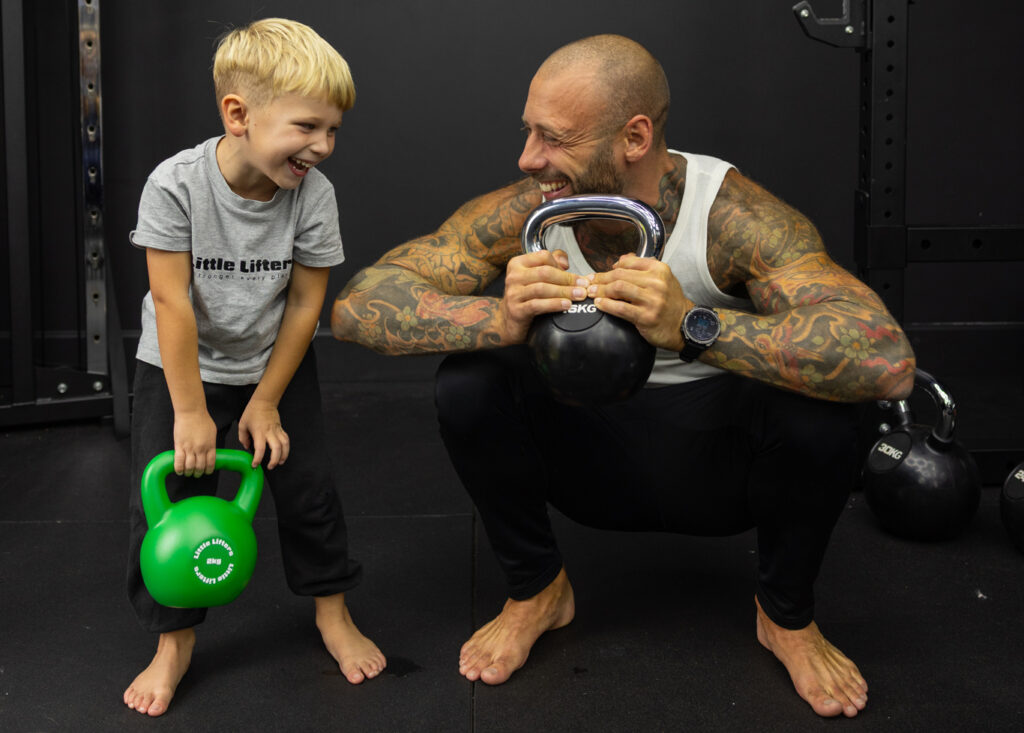
Like It or Not, Your Kids Will Copy What You Do, Not What You Say
It’s easy to believe your kids are shaped by what you tell them.
Eat well. Be active. Work hard. Look after yourself.
But that’s not what sticks. What sticks is what you do.
Not the big speeches or the occasional reminder, but the quiet, repeated behaviours they see every day. The way you move. The way you eat. The way you deal with things when you’re tired or busy or not in the mood.
That becomes their normal. That becomes the standard they grow up with.
This hit me again this week. I took my son to Ninja Warrior in Leicester. One of those places where kids can run, climb, swing, test themselves. It should be chaos, in a good way.
What stood out wasn’t the kids. It was the parents. Most were sat in the café, scrolling on their phones, watching from a distance. Not involved. Not moving. Just there. And I get it. People are tired. Life is busy.
But I couldn’t ignore the gap.
I was in there with him. Running around, climbing, showing him how to do things, having a go myself. There wasn’t an obstacle in there I couldn’t do.
Not because I’m special. Because I stay capable.
That’s the point. This isn’t about being the fittest person in the world. It’s about being capable enough to take part. Capable enough to lead from the front. Capable enough to set the example without saying a word.
Because that’s what your kids take from you.
Not what you say. What you show them.
If your default is to sit, they see that. If your default is to move, they see that too. If your default is to look after yourself, to train, to push a little when it’s uncomfortable, that becomes normal to them.
That becomes their baseline. And that’s a gift.
People often frame this as selfish. Taking time to train, to look after yourself, to focus on your own health. As if it’s time taken away from your family.
It isn’t. It’s what allows you to show up properly for them.
With more energy. More patience. More presence. You can’t give anything from an empty cup.
And it goes further than that. It’s about being capable when it matters.
Capable to run to them if they need you. Capable to carry them. Capable to step in, physically and mentally, when something goes wrong.
We should be aiming to be the most capable person in the room.
Not for ego. For responsibility.
That’s what training is about.
And this isn’t just about having kids. Even if you don’t, even if you never plan to, you’re still setting a standard. To the people around you, to your friends, to your family.
And most importantly, to yourself. Because what you accept becomes what you live.
There’s a tendency to blame age for decline. To assume that slowing down, falling apart, losing capacity is just part of getting older.
Most of the time, it isn’t. It’s years of habits stacking up. Less movement. Poorer choices. Small decisions repeated over and over again until they become the default.
That’s not ageing. That’s compounding. And it works both ways.
I didn’t start running until I was 36. At the time, I was close to 100kg, focused on bodybuilding, and I couldn’t run two miles without feeling like iI was going to die.
Now I’ve done marathons. Ironmans. Things I wouldn’t have thought were possible back then.
Not because I’m different. Because I changed what I did, and I stuck to it long enough for it to matter.
You will always wish you started earlier. Everyone does.
But you didn’t. All you have is now. And what you do next.
Because one day, someone will look at your child and say:
“You’re just like your mum.”
“You’re just like your dad.”
And that moment is coming whether you think about it or not. The only question is what that actually means.
Is it a compliment?
Or isn’t it?
Because that part is on you. And it’s worth asking yourself something simple.
If your children grew up and lived exactly the way you do right now, would you genuinely be proud?
Not what you say. What you do.
The habits. The standards. The way you show up day to day.
If the answer is yes, keep going.
If it isn’t, then you already know what needs to change.