You Don’t Need a Gym. You Never Did.
I’ve been a gym member since I was 16.
For nearly two decades, the gym was where fitness happened. Full stop. If I was on holiday and there was no gym, I didn’t train. I didn’t move. I just wrote the week off and told myself I’d get back to it when I was home. The gym wasn’t just somewhere I trained, it had become a condition of training. A prerequisite. No gym, no fitness. That was the deal I’d made with myself without even realising it.
Then my mid-thirties happened, and everything changed.
The past three years I’ve travelled more than ever before. I’ve done hours of open water sea swimming. I’ve run along beaches and up mountains. I’ve walked 30,000 steps a day through cities. I’ve done calisthenics in more Airbnbs than I have in gyms. And what I’ve learned from all of it has fundamentally shifted how I think about fitness.
The gym is great. I love gyms. I love weights. This isn’t a piece about bashing gym culture.
But the gym is not the point. Movement is the point. And the gym is one of many ways to get there — not the only one.
The Excuse We Don’t Talk About
Most people think the gym solves the problem of not being fit. But for a surprising number of people, the gym has quietly become the excuse.
“I’ll start when I get a membership.” “I can’t train this week, I’m away.” “I’d go but it’s too far, too expensive, too busy, too intimidating.”
I’ve said all of these. Probably more than once. And what they all have in common is that they hand the responsibility for your fitness to a building. The moment the building isn’t available, you’re off the hook.
That’s not a gym problem. That’s a mindset problem. And the fix is simpler than most people want to admit.
Walking Is the Most Underrated Thing You Can Do
Before we get to workouts, let’s talk about the thing that requires no equipment, no membership, no commute, and that the research suggests might be the most powerful health tool most of us are ignoring.
Walking.
Studies published in JAMA found that walking around 10,000 steps a day is linked to reduced risk of cardiovascular disease, 13 types of cancer, stroke, and heart failure. Research suggests that 9,800 steps a day is the optimal dose for lowering the risk of dementia by 50%. Even at just 7,500 steps, meaningful improvements in longevity and chronic disease risk have been recorded. One study found that every 2,000 steps walked per day was associated with a reduced risk of premature death.
And here’s the part that should make you sit up: people who walked between 9,000 and 10,000 steps a day showed a 39% reduction in risk of death and a 21% reduction in cardiovascular disease risk.
No pill. No programme. No gym. Just walking.
I walked 30,000 steps a day for stretches while travelling through cities and felt physically better than some of my heaviest training weeks. There’s something about sustained, low-level movement throughout the day that formal exercise sessions don’t fully replicate. Your body was designed to move, not to sit still for eight hours and then hit it hard for an hour.
If you don’t know where to start, start here. Walk more. Every day. It compounds.
The Secret Gyms Hidden in Plain Sight
Before we even get to home workouts, there’s something most people walk past every day and don’t think twice about.
Outdoor calisthenics parks.
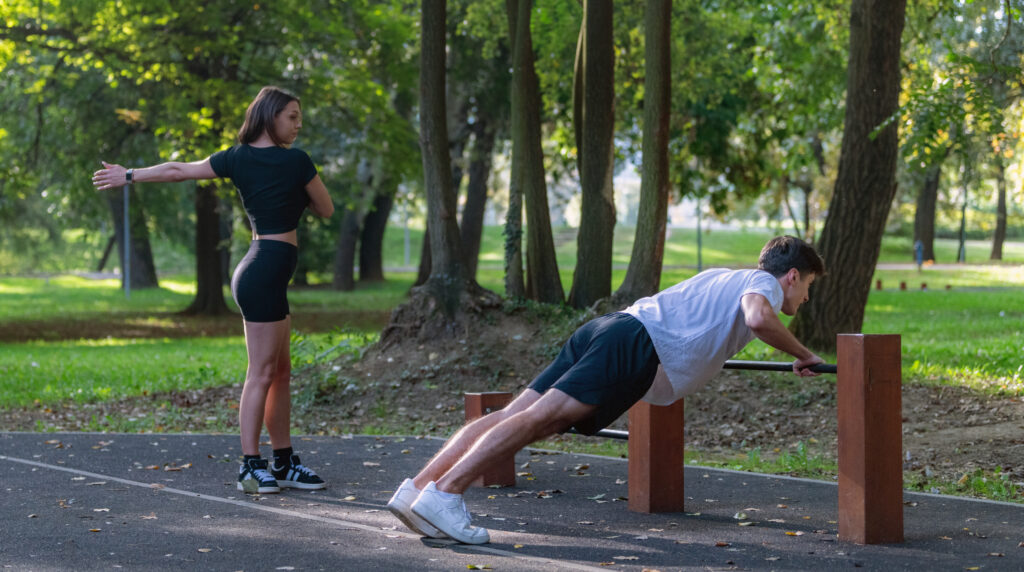
They’re everywhere now. Parks, seafronts, recreational areas, town centres — councils across the UK have been installing them steadily over the past decade and there are more of them than most people realise. Pull-up bars, parallel bars, dip stations, monkey bars, climbing frames. All of it free. All of it outdoors. Open every day, no membership required, no commute to speak of.
If you’re someone who doesn’t mind training in front of other people — and I’d encourage you to get over it if you do — an outdoor calisthenics park gives you everything you need for a complete strength and conditioning session. The equipment is solid, the fresh air is free, and you might even find a community of people training there regularly.
A quick search on Google Maps for “calisthenics park” or “outdoor gym” near your location will show you what’s available. You might be surprised how close one is. Use it.
You Don’t Need Equipment. You Need 30 Minutes.
Here’s what most people don’t realise: your body is the best piece of training equipment you own. Bodyweight training, done properly, builds real strength, real conditioning, and real fitness. You can do it in your garden, on your driveway, in a park, in a hotel room, on a beach.
The workouts below are both around 30 minutes. They’re full body. They balance strength and conditioning — not one or the other, because you need both. They’re not easy. Don’t mistake simple for easy.
Workout 1: No Equipment (Garden / Outdoors / Anywhere)
Warm up for 3–5 minutes: jog on the spot, arm circles, leg swings, bodyweight squats x10.
Complete 4 rounds of the following circuit. Rest 60 seconds between rounds.
- 10 x Push-Ups (chest to floor, full extension — scale to incline if needed)
- 15 x Bodyweight Squats (deep, controlled, drive through the heels)
- 10 x Reverse Lunges each leg (slow and controlled on the way down)
- 10 x Pike Push-Ups (hips high, targeting the shoulders)
- 20 x Mountain Climbers (drive the knees in, keep the hips level)
- 30 sec Plank Hold
- 10 x Glute Bridges (squeeze hard at the top, pause for a second)
- 10 x Burpees (the one everyone hates and everyone needs)
That’s it. 4 rounds. You’ll work every major muscle group, push your cardiovascular system, and finish knowing you’ve done something that matters. Total time including warm-up: around 30 minutes.
Workout 2: With a Pull-Up Bar
A pull-up bar changes everything. You don’t need a fancy one — a door frame bar costs less than a month’s gym membership, a bar bolted to a fence or attached to a tree does the job. Even a low bar for Australian pull-ups works. The point is to be able to pull your bodyweight.
Adding a pulling movement is the missing piece for most people doing bodyweight work. Push-ups train the push. Pull-ups train the pull. Without both, you’re building an imbalanced body.
Warm up for 3–5 minutes as above.
Complete 4 rounds of the following circuit. Rest 60–90 seconds between rounds.
- 5–8 x Pull-Ups (full hang to chin over bar — scale to jumping pull-ups or Australian pull-ups if needed)
- 12 x Push-Ups
- 12 x Bodyweight Squats
- 8 x Hanging Knee Raises (from the pull-up bar, controlled, no swinging)
- 10 x Dips (use a chair, bench, or low wall)
- 10 x Jump Squats (land soft, load the hips)
- 30 sec Dead Hang (grip strength, shoulder health, mental discipline)
- 10 x Burpees
Upper body pull, upper body push, lower body strength, core, and conditioning. 30 minutes. No excuses.
My Favourite Quick Workout
If I had to strip everything back to one session I’d do anywhere, any time, with nothing but a pull-up bar, it’s this.
Three movements. That’s it.
- 10 x Pull-Ups
- 20 x Push-Ups
- 30 x Bodyweight Squats
Complete as many full rounds as you can at those numbers. When you can no longer hit the full set cleanly, ladder down: 9 pull-ups, 18 push-ups, 27 squats. Then 8, 16, 24. Keep going until you reach failure.
It sounds simple. It is not simple. Done properly, this session will test your pulling strength, your pushing endurance, your legs, and your mental resolve. It scales to any level — a beginner might get three rounds before dropping, someone advanced might push through six or seven before the ladder begins. Either way, you’ll have worked.
I come back to this one constantly. On the road, in the garden, at outdoor parks, on holiday. It never gets easier — you just get better at it.
The Point of All of This
I’m not saying stop going to the gym. I still go. I still love lifting heavy things. But I’m fitter and more capable than I’ve ever been, and a significant part of that has come from learning to train everywhere — not just inside a gym.
Don’t like running? Get a bike. Can’t swim? Walk. Can’t afford a gym? Your garden, a £15 pull-up bar, and the calisthenics park down the road will build you a better body than most people have. The barrier to fitness is almost never the equipment or the location.
It’s always the decision.
Make it.